How an AI-Powered Feedback System Transforms Customer Insight into Action
Every customer message is a signal. But when your team receives hundreds or thousands of them each week, separating the urgent complaints from the quiet feature requests becomes nearly impossible. I have spent years inside support and product teams, watching us drown in spreadsheets, tagging systems that no one uses, and weekly meetings where we guess what customers actually want. The problem is not that we lack feedback. The problem is that we lack a system that makes sense of it.
What changes everything is a feedback platform that can read, cluster, and prioritize those messages without a person having to open each one. That is where the idea of an AI-powered feedback system comes in. And one implementation that I have seen work well is the AI-powered feedback system Loopback, which treats every customer message not as noise but as raw material for better decisions.
The Feedback Avalanche
Early in my career, I ran customer insights for a SaaS company with about 12,000 active accounts. We used a shared mailbox, a CRM, and a productboard instance. Every week my team would export tickets, manually tag them by theme, and present a summary to the product team. We were slow. We missed patterns. We argued over whether a request for “better reporting” was the same as “I need to export my data.” Sometimes we agreed they were different, other times we lumped them together out of exhaustion.
The result was that the loudest customers got the most attention. The quiet ones, the ones who sent a single bug report at 2 AM, got lost. Over time, our product roadmap became a reflection of who shouted loudest, not what most customers needed. That is the real cost of manual feedback management: you spend more time organizing the feedback than acting on it.
Why Manual Tagging Fails at Scale
Many teams try to solve this with tagging taxonomies. You create categories: bug, feature request, complaint, praise. You assign subcategories. You train your support team to tag every ticket. It sounds reasonable. In practice, it breaks down for three reasons.
First, consistency. Two agents tag the same message differently depending on their mood, their training, or how tired they are at 4 PM. Second, speed. Tagging takes time, and during a support spike, tagging is the first thing that gets skipped. Third, nuance. A single customer email often contains a bug report, a feature request, and a question all in one paragraph. No tag captures that. By the time you have simplified the message into a category, you have already lost the context that matters.
What an AI-Powered Feedback System Actually Does
An AI-powered feedback system does not replace human judgment. It replaces the manual labor of reading, categorizing, and counting. The difference is subtle but critical. The system reads each message, identifies the underlying intent, and groups it with similar messages from other customers. It does not just look for keywords. It understands phrasing, sentiment, and context.
For example, if ten customers write “The search function is too slow,” and five others write “I keep waiting for results when I look up orders,” the system recognizes those as the same issue. A human might miss that connection if the phrasing is different. The system also tracks frequency. If one issue appears in 30% of all messages this week, the system surfaces it as a priority. If another issue appears in 2% of messages but comes from high-value accounts, the system can flag that too.
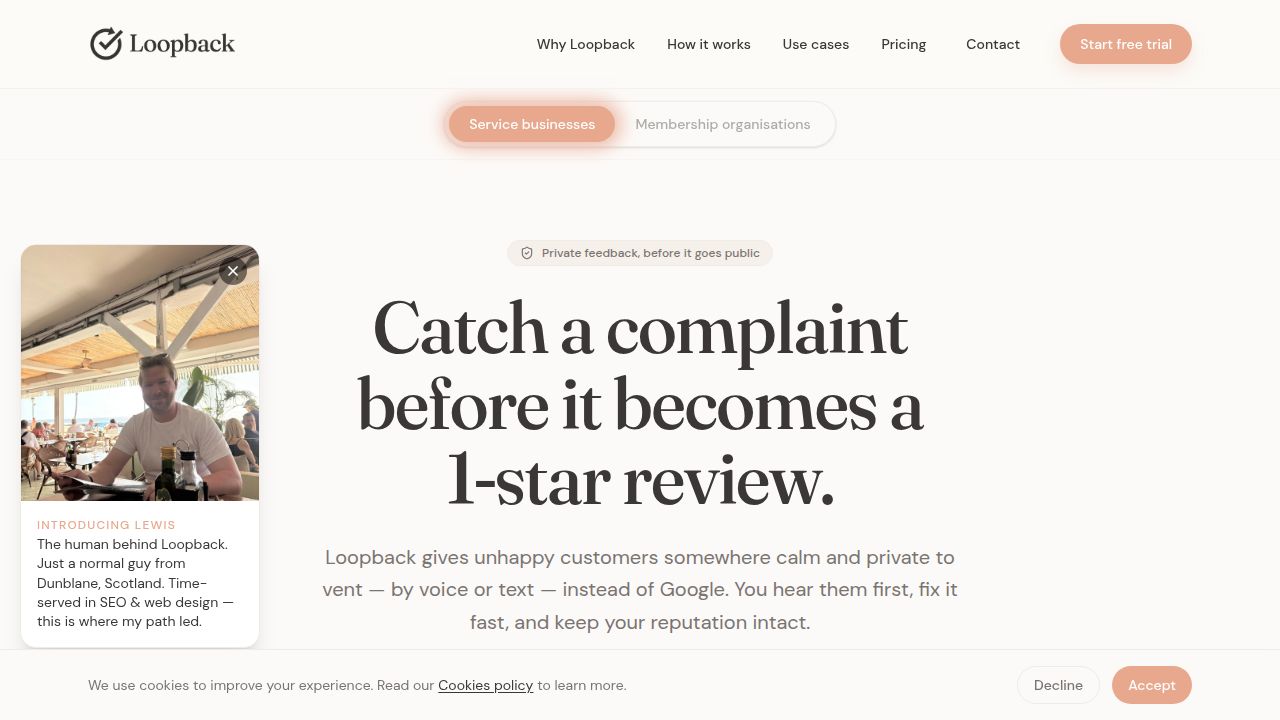
This is where the AI-powered feedback system Loopback stands out. It organizes messages into clusters that reflect real customer concerns, not arbitrary categories. It summarizes each cluster in plain language so that a product manager or a support lead can read one paragraph instead of fifty emails. And it tracks how those clusters change over time, so you can see whether a fix you shipped last month actually reduced complaints about a specific feature.
Moving from Reactive to Proactive
The biggest shift I have observed in teams that adopt this kind of system is not in how they handle support tickets. It is in how they plan their work. Before, they were reactive. A customer complained, they fixed it, and they moved on. After, they could see patterns forming before the complaints became a crisis.
One product team I worked with used the system to spot that a recent UI change had caused a spike in confusion about a specific button. Within three days of the change going live, the system surfaced the issue. The team rolled back the change, tested an alternative, and deployed it. That entire cycle took less than a week. Without the system, they would have heard about the problem from a few angry customers, maybe discussed it in a meeting, and then taken a month to investigate. The difference was not just speed. It was the fact that they knew the scope of the problem before it escalated.
The Trade-offs You Should Know About
No system is perfect. AI-powered feedback systems rely on the quality of the data they receive. If your team is inconsistent about logging feedback, or if you pull data from only one channel, the system will give you an incomplete picture. The output is only as good as the input. Another trade-off is the risk of over-automation. If you trust the system blindly, you might miss edge cases that require human intuition. The best approach is to use the system as a filter and a sorter, not as a decision-maker. Let the AI do the heavy lifting of organization, but keep a human in the loop for the final call.
There is also the question of setup time. Getting an AI-powered feedback system configured for your specific vocabulary and workflows takes upfront effort. You need to feed it enough examples so that it learns what matters to your business. In my experience, that investment pays back within a few weeks once the system starts surfacing insights that your team would have missed.
Practical Steps for Getting Started
If you are considering adopting a system like this, start with a single channel. Maybe it is your support email, or your in-app chat, or your community forum. Do not try to ingest everything at once. Let the system learn on one source, validate that the clusters make sense, and then expand. Train your team to trust the summaries but to verify when something feels off. Over time, the system becomes more accurate as it sees more data.
Also, decide early how you will act on the insights. A feedback system that produces beautiful summaries but no one reads is a waste. Assign someone on the product or operations team to review the output weekly. That person should have the authority to escalate issues or to kill projects that are not aligned with what customers actually need.
Closing Thought
Customer feedback is the most direct signal you have about what your product needs to become. But raw feedback is not insight. It is just data. An AI-powered feedback system turns that data into something your team can use without drowning in it. The AI-powered feedback system Loopback, in particular, shows how this approach can be practical and scalable for teams that are serious about listening to their customers and acting on what they hear. The technology is not magic. It is just a better way to pay attention.